Understand Genetic Causes of
Hearing, Voice & Balance
Advanced Genetic Testing for Hereditary ENT Disorders
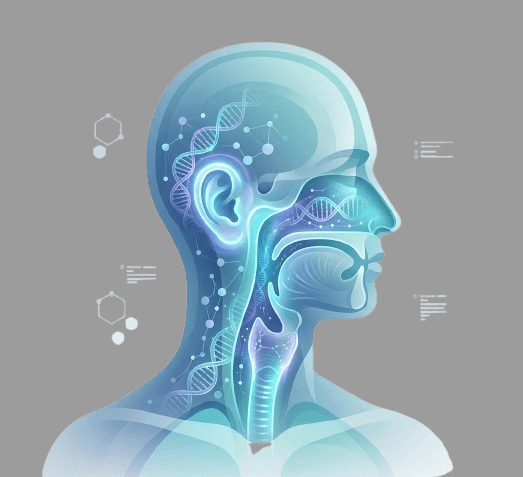
Gene Coverage
171 ENT-Related Genes
Turnaround
7–10 Days
Hereditary ENT genetic testing identifies mutations affecting hearing, balance, airway function, and speech development—enabling early diagnosis and precision intervention before symptoms progress.
171
Total Genes
>96%
Read Depth
Deciphering Inherited
ENT Disorders
Hereditary ENT disorders are genetically influenced conditions affecting hearing, speech, balance, and airway function due to mutations impacting sensory and structural pathways.
These conditions often develop silently at the genetic level before clinical symptoms appear. Understanding the molecular drivers behind inner ear structures or nasal dynamics enables healthcare providers to intercede proactively.
Why ENT Medicine is Moving Toward Genomic Precision
Early Detection
Identify hearing loss risk before symptoms appear.
Diagnostic Clarity
Differentiate between overlapping ENT disorders.
Personalized Treatment
Match interventions to genetic mechanisms.
Speech & Hearing Preservation
Prevent irreversible sensory decline.
Balance Disorder Insight
Understand vestibular dysfunction origins.
Family Risk Mapping
Enable cascade screening for relatives.
Genetic Disorders Affecting ENT Function
Our comprehensive sequencing pipeline tests for mutations responsible for auditory, vestibular, vocal, and syndromic sensory impairments. Click on any condition to expand genomic details.
Hearing Loss (GJB2, GJB6)
Most common genetic hearing impairment. Gap junction dysfunction. Congenital or progressive.
Usher Syndrome (USH2A, MYO7A)
Hearing + vision loss. Inner ear hair cell dysfunction. Dual sensory impairment.
Waardenburg Syndrome (PAX3, SOX10)
Hearing loss + pigmentation changes. Eye color variation. Neural crest development disorder.
Branchiootorenal Syndrome (EYA1)
Hearing loss + kidney anomalies. Developmental syndrome.
Otosclerosis (COL1A1, COL11B2)
Abnormal middle ear bone growth. Progressive conductive hearing loss.
Pendred Syndrome (SLC26A4)
Hearing loss + thyroid involvement. Inner ear fluid imbalance.
Stickler Syndrome (COL2A1, COL11A1)
Hearing + vision + joint abnormalities. Collagen structural defects.
Jervell and Lange-Nielsen Syndrome (KCNQ1, KCNE1)
Hearing loss + cardiac rhythm risk. Inner ear potassium transport dysfunction.
Neurofibromatosis Type II (NF2)
Auditory nerve tumors. Progressive hearing loss.
Why ENT Specialists Use Genetic Testing
Diagnostic Precision
Clarify complex hearing loss origins.
Early Intervention
Prevent irreversible auditory damage.
Treatment Planning
Guide hearing aids, therapies, and surgical decisions.
Family Risk Detection
Identify inherited ENT conditions early.
Multisensory Evaluation
Assess hearing + balance + speech disorders together.
Comprehensive 171-Gene ENT Panel
Covers genes associated with syndromic and non-syndromic hearing impairment, balance disorders, speech delays, and structural ENT abnormalities.
ENT Gene Explorer
Our comprehensive sensory sequencing targets individual molecular pathways linking inner ear cochlear structures, fluid mechanics, neural connectivity, and vocal frequency meshes.
View Full 171-Gene Index
Search individual ENT genes or explore the complete list of targeted genetic elements.
How ENT Genetic Testing Works
Clinical ENT Assessment
Hearing, speech, balance evaluation.
Sample Collection
Simple saliva or buccal swab.
NGS Sequencing
ENT gene analysis.
Variant Interpretation
Pathogenic classification.
Clinical Reporting
Risk + treatment guidance.
Is ENT Genetic Testing Right for You?
Clinical guidelines recommend testing for patients exhibiting specific family or diagnostic indicator histories.
Target Indicator
Family history of hearing loss
Target Indicator
Early-onset deafness or speech delay
Target Indicator
Balance disorders (vertigo)
Target Indicator
Congenital ENT abnormalities
Target Indicator
Progressive hearing decline
Target Indicator
Syndromic sensory conditions
Test Specifications
Acceptable sample requirements
Buccal Swab or Saliva
Turnaround time
7-10 Business days
Gene panel
171 Curated Genes
Testing Method
Next Generation Sequencing (NGS)
Reporting
Likely pathogenic and Pathogenic variants
Coverage
>96% Coverage at 20x Depth
Precision Genomics for ENT Care
High-Resolution Sequencing
ENT-focused genomic interpretation and read quality.
Fast Reporting
Clinical diagnostic results delivered within business days.
Comprehensive Panel Design
Broad sensory gene coverage assessing all 171 auditory-vocal targets.
Clinical Collaboration
ENT specialist support system providing diagnostic coordination.
Patient Education Hub
Built for Precision
ENT Medicine
Connect our sensory genomic testing straight to your clinical practice with high-trust digital provider features:
Provider ordering dashboard
Initiate buccal swab and saliva kits directly from the clinic.
Genetic ENT reporting system
Interactive HTML and PDF reporting matching modern pathology layouts.
Family cascade tracking
Trace inherited genetic mutations through first-degree relatives.
Hearing risk stratification
Define pre-symptomatic risks using high depth exome read structures.
Long-term monitoring tools
Integrate genomic insights with audiometric screening files.
Preserve Hearing, Voice & Balance
Through Genetic Intelligence
Detect inherited ENT disorders early and enable precision interventions that protect sensory function across generations.